Legal
Privacy Policy
Effective August 23, 2026 · Updated October 1, 2026
This Policy explains how StorySplice collects, uses, shares, and retains information when you visit storysplice.cloud, create an account, generate media, or contact support. StorySplice is currently a beta AI-assisted video creation service. Questions or privacy requests may be sent to support@storysplice.cloud.
1. Information we collect
Account and authentication information
When you register with email, we process your display name, email address, password hash, verification status, session information, and password-reset records. We do not store your plaintext password. If you use Google sign-in, we receive the basic account information Google makes available for authentication, such as your name, email address, profile image, and a provider-specific account identifier. StorySplice does not request access to Google Drive, Gmail, YouTube, or your Google password.
Content and project information
We process the topics, scripts, prompts, keywords, voice and subtitle settings, uploaded local videos, uploaded background music, job status, generated audio, stock-footage selections, captions, and finished videos needed to provide the Service. Support messages and any files or information you choose to send us are also processed.
Technical information
Our servers may record IP address, request time, browser or device information, requested URLs, error details, and security events. We use essential cookies or similar session storage to keep you signed in and protect your account. StorySplice does not currently use advertising cookies or third-party behavioral analytics.
The homepage demo and its thumbnail are hosted by StorySplice. Playing the demo does not load a YouTube player or third-party tracking. The alternative “Watch on YouTube” link opens YouTube, where Google’s own privacy policy applies. See our cookie notice for details.
2. How we use information
- Authenticate users, verify email addresses, and recover accounts.
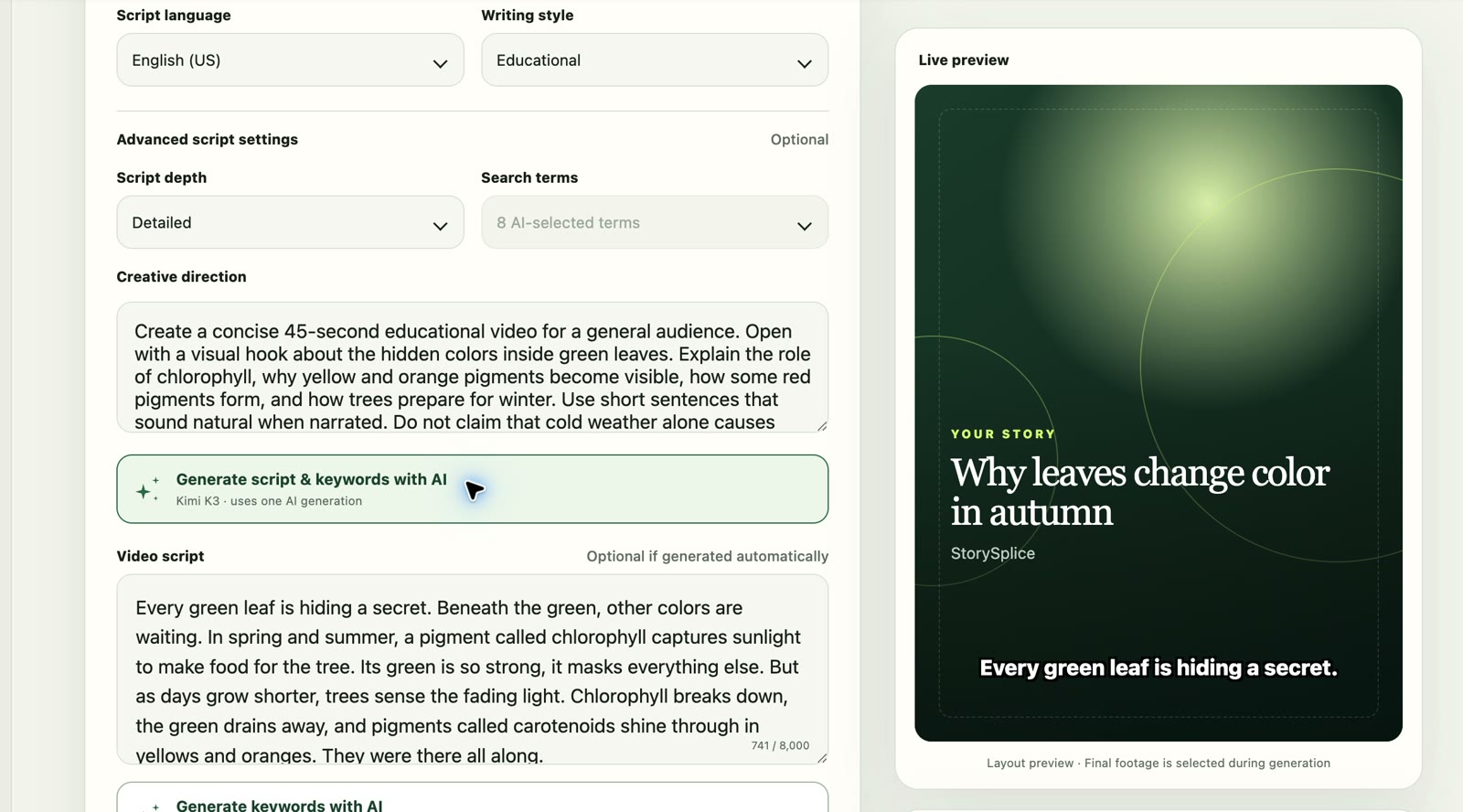
- Generate scripts, search terms, narration, captions, stock-footage compositions, and downloadable videos at your request.
- Operate private previews and downloads and associate jobs with the correct account.
- Provide transactional emails and customer support.
- Prevent abuse, enforce usage limits, diagnose failures, maintain availability, and improve the beta.
- Comply with legal obligations and protect users, StorySplice, and third parties.
Where applicable, we rely on performance of our contract with you, legitimate interests in operating and securing the Service, consent where requested, and compliance with legal obligations.
3. Service providers and data sharing
StorySplice is an independent application built on third-party AI models and services, not the developer of those models. Inputs needed for writing, media search, narration or scene generation are sent to the relevant provider. Avoid submitting confidential or sensitive personal information in your topics, scripts and prompts.
We share information only as needed to provide or protect the Service. Current service providers and integrations may include:
- Hostinger for VPS infrastructure, storage, network services, and the StorySplice support mailbox.
- Google when you choose Google sign-in. Google’s handling of information is described in its Privacy Policy.
- Resend for transactional verification and password-reset email delivery.
- Kimi to generate scripts and search terms from the topics, instructions, or scripts you submit.
- Pexels, Pixabay and Coverr receive search keywords when their stock-media source is selected.
- Shengsuan Cloud / LoomLoom and its underlying model providers process scene-generation prompts derived from submitted topics, scripts or keywords when an authorized user selects the experimental generative video source.
- Microsoft Edge text-to-speech services to synthesize narration from submitted script text and selected voice settings.
We may also disclose information when required by law, to investigate fraud or security incidents, to protect legal rights, or as part of a business reorganization subject to appropriate safeguards. We do not sell personal information or Google user data.
4. Google user data
Google account information is used only to create and secure your StorySplice account, display your account identity, and maintain your authenticated session. We do not use Google user data for advertising, sell it, or permit humans to read it except when necessary for security, support requested by you, legal compliance, or operation of the authentication service. You can revoke StorySplice access through your Google Account settings, though revocation does not automatically delete the StorySplice account record already created.
5. Retention and deletion
Generated task media—including intermediate files, narration, uploaded local videos, uploaded background music, voice samples, captions, and completed video files—is scheduled for automatic deletion from active task storage after seven days. You can permanently delete a completed or failed video earlier from Your recent videos. Voice-preview access tokens normally expire within thirty minutes, although the underlying generated sample remains subject to the seven-day task cleanup.
Account information, authentication records, support correspondence, security logs, and project metadata may be retained while your account is active and afterwards when reasonably necessary for security, legal compliance, dispute resolution, or service administration. Backup copies may remain until the relevant backup cycle expires. Download any video you wish to keep before its deletion date.
You may request account or personal-data deletion by emailing support@storysplice.cloud. We may need to verify your identity and may retain limited records where legally required or necessary to prevent abuse.
6. Security
We use HTTPS, restricted server credentials, access controls, private per-user media routes, password hashing, rate limits, and operational monitoring. No online service can guarantee absolute security. You are responsible for using a strong password and protecting access to your email and Google account.
7. International processing
StorySplice and its service providers may process information in countries other than your own. Where required, we use appropriate contractual or legal safeguards for cross-border processing.
8. Your choices and rights
Depending on your location, you may have rights to access, correct, delete, restrict, or object to processing, or obtain a portable copy of certain personal information. You may also withdraw consent where processing relies on consent and complain to an applicable data-protection authority. Contact us to exercise a request.
9. Children
The Service is not directed to anyone under 18, and we do not knowingly collect personal information from children. Contact us if you believe a child has provided information to StorySplice.
10. Changes
We may update this Policy as the beta, its providers, or legal requirements change. We will post the revised effective date and provide additional notice when required by law.
11. Contact
Email privacy questions or requests to support@storysplice.cloud.
Legal
Terms of Service
Effective August 23, 2026 · Updated October 1, 2026
StorySplice is an independent application that uses third-party AI models and services. Standard video creation assembles existing stock or uploaded footage; editable AI-assisted writing and synthetic narration are separate from the experimental generation of new visual scenes. Third-party providers do not endorse StorySplice.
These Terms govern access to storysplice.cloud and the StorySplice AI-assisted video creation service (the “Service”). By creating an account or using the Service, you agree to these Terms and the Privacy Policy. If you do not agree, do not use the Service.
1. Beta service and eligibility
You must be at least 18 and legally able to enter this agreement. If you use StorySplice for an organization, you confirm that you have authority to bind it. StorySplice is in beta: features may be incomplete, changed, rate-limited, interrupted, or removed as we test and improve the Service.
2. Accounts
Provide accurate registration information, keep credentials confidential, and promptly notify us of suspected unauthorized access. You are responsible for activity conducted through your account. You may not sell, transfer, share, or use another person’s account without authorization.
3. Your content and generated output
You retain rights you already hold in topics, scripts, prompts, files, branding, and other material you submit (“Input”). You grant StorySplice a limited license to host, process, reproduce, and transmit Input only as needed to operate, secure, and improve the Service.
As between you and StorySplice, and to the extent permitted by law, you may use generated output for lawful personal or commercial purposes. AI output may not be unique, and similar material may be produced for other users. StorySplice does not guarantee that output is accurate, original, protectable, non-infringing, or suitable for a particular purpose.
4. Your responsibilities
You are responsible for reviewing every script, claim, caption, voiceover, visual, and finished video before publishing. You must obtain all rights, permissions, releases, and licenses required for your Input and intended use, including rights involving copyright, trademarks, music, privacy, publicity, faces, voices, and likenesses. Stock media and third-party platforms remain subject to their own licenses and rules.
5. Acceptable use
You may not use StorySplice to:
- Break the law, violate another person’s rights, or evade legal or platform obligations.
- Create fraud, scams, deceptive advertising, impersonation, non-consensual intimate content, exploitative material, or misleading synthetic media.
- Generate or distribute malware, instructions for harmful wrongdoing, or content that facilitates violence or abuse.
- Use a person’s face, voice, identity, or confidential information without a lawful basis and necessary permission.
- Infringe copyright, trademark, publicity, privacy, or other proprietary rights.
- Probe, disrupt, overload, scrape, reverse engineer, bypass rate limits, or compromise the Service or another user’s account.
- Represent that StorySplice endorses your content, claims, products, or services.
We may remove content, restrict generation, suspend accounts, or preserve and report information where reasonably necessary to address abuse, security threats, legal process, or repeated infringement.
6. AI and publishing disclaimer
StorySplice is a creation tool, not an editor, publisher, fact checker, lawyer, financial adviser, medical professional, or platform-approval service. Generated scripts and media can contain errors, bias, outdated information, unexpected content, or third-party material. You—not StorySplice—decide whether, where, and how output is published and are responsible for required disclosures, substantiation, and compliance.
We do not guarantee acceptance, reach, advertising approval, monetization, revenue, engagement, or continued availability on YouTube, TikTok, Instagram, or any other platform. Third-party platforms may remove content or restrict accounts under policies StorySplice does not control.
7. Third-party services
The Service depends on providers such as Google, Hostinger, Resend, Kimi, Pexels, and Microsoft text-to-speech services. Their availability, pricing, output, and terms can change independently. StorySplice is not responsible for outages or decisions made by those providers, but we will use reasonable efforts to maintain the Service.
8. Storage and deletion
Generated task media is temporary and scheduled for deletion after seven days. You are responsible for previewing and downloading files you want to keep. Account records and limited project metadata may remain as described in the Privacy Policy. We may remove abandoned, unlawful, unsafe, or technically harmful content sooner.
9. AI credits, usage limits and billing
See the Refund & Cancellation Policy for payment inquiries, planned cancellation terms and the distinction between restoring AI credits and refunding a payment. Paid checkout remains unavailable.
Free Trial provides 30 one-time AI credits. Standard video submissions reserve 10 credits for a maximum length up to 30 seconds or 15 credits for 31–60 seconds, including any end card. Confirmed failed renders have their credits restored automatically. Unconfirmed submissions stay reserved until resolved. Previewing or downloading an existing video does not use credits.
Both plans have separate beta capacity limits: one active render per account and two submissions per day, resetting at 00:00 UTC. Failed submissions count toward this daily limit. Attempts to circumvent limits are prohibited. Experimental AI scenes require a separate invitation and are excluded from Creator Beta credits.
Creator Beta is planned at $15/month with 300 AI credits per monthly billing period. Paid checkout is not enabled. Once launched, subscriptions will renew monthly until canceled; cancellation stops future renewals and access continues through the paid period. Unused monthly credits will not roll over. Existing paid periods keep their original allowance and expiration date. Applicable taxes, final charges and refund terms will be shown before purchase; statutory rights are unaffected. Registering does not authorize a charge. See Pricing or contact Support.
10. StorySplice intellectual property
StorySplice’s software, interface, branding, documentation, and underlying systems are owned by or licensed to the StorySplice operator. These Terms provide a limited, revocable, non-exclusive, non-transferable right to use the Service; they do not transfer ownership of the platform or its technology.
11. Suspension and termination
You may stop using the Service at any time. We may limit, suspend, or terminate access when we reasonably believe you violated these Terms, created security or legal risk, failed to pay an applicable future charge, or materially harmed the Service or others. Where practical and lawful, we will provide notice and an opportunity to address the issue.
12. No warranties
To the maximum extent permitted by law, the Service is provided “as available” without warranties of uninterrupted operation, merchantability, fitness for a particular purpose, non-infringement, or accuracy. Nothing in these Terms excludes warranties or consumer rights that cannot legally be excluded.
13. Limitation of liability
To the maximum extent permitted by law, StorySplice and its operator will not be liable for indirect, incidental, special, exemplary, punitive, or consequential loss, or for lost profit, revenue, data, goodwill, business opportunity, platform access, or expected savings arising from the Service. StorySplice’s aggregate liability for claims relating to the Service will not exceed the greater of the amount you paid StorySplice during the twelve months before the event giving rise to the claim or USD 100. These limits do not apply where liability cannot lawfully be limited.
14. Indemnity
To the extent permitted by law, you will defend and indemnify StorySplice and its operator against third-party claims, damages, and reasonable costs arising from your Input, output, publication, unlawful use, infringement, or material breach of these Terms. This obligation does not apply to the extent a claim was caused by StorySplice’s own unlawful conduct.
15. Changes and general terms
We may update the Service or these Terms. Material changes will receive notice when required, and the revised effective date will be posted. If a provision is unenforceable, the remainder stays effective. Failure to enforce a provision is not a waiver. Neither party is liable for delay caused by events beyond reasonable control.
Applicable law governs these Terms without removing mandatory protections available in your place of residence. Before filing a claim, contact us so the parties can attempt to resolve the issue in good faith.
16. Contact
Questions, notices, or infringement reports may be sent to support@storysplice.cloud. Include enough information for us to understand and investigate the request.