Start with an idea
Use a short topic, generate a script with AI, or paste your complete narration.
AI video studio
Use AI-assisted writing, matched stock footage, multilingual voiceover, background music and styled captions to create a ready-to-download MP4.
See the workflow
Explore the StorySplice workspace, choose a voice, music and captions, then preview and download the finished MP4.
Click the thumbnail to watch · Hosted by StorySplice. Video and sound start only when you choose to play.
Watch on YouTube ↗Recorded September 13, 2026. This walkthrough demonstrates the video-creation workflow using a prepared script and keywords. The rendering wait is shown at 10× speed. Narration and background music were added to the screen recording. Features and pricing may change; paid checkout was pending activation when recorded.
A focused workflow
StorySplice keeps the whole creation process in one workspace, without making you learn a traditional video editor.
Use a short topic, generate a script with AI, or paste your complete narration.
Choose the format, duration, footage order, voice, music, and caption style.
Review the generated video in your browser and save the finished MP4 locally.
Built for fast creation
Practical controls for scripting, visuals, sound, captions, preview, and export—powered by the StorySplice render engine.
Draft editable narration and visual search terms from a single topic.
Search Pexels and arrange relevant footage around the story.
Preview natural voices and control narration speed and volume.
Burn readable subtitles into the video with configurable placement and design.
Watch the completed result in StorySplice before downloading it.
Download a finished MP4 for publishing, with seven-day temporary storage.

A complete example
Follow one project from a focused topic through an editable script, ordered visual searches, narration, caption styling and final export settings.
Real rendered output
Each case study includes the playable MP4, production settings and honest quality-control notes. No testimonials or performance figures are invented.
Designed around real workflows
Start with a clear communication goal, then choose the format, pacing and creative controls that fit the audience.
Turn an original script into a vertical narrated video without recording yourself on camera.
Pair a concise lesson with relevant footage, readable captions and consistent narration.
Build a short narrative around a product idea, customer problem or campaign concept.
Choose supported voices and subtitle styling for audiences that prefer different languages.
Transparent beta access
Start with 30 one-time AI credits. Create videos up to 60 seconds, with separate beta capacity limits of one active render and two submissions per day.
Built with practical safeguards
StorySplice is an independent application using third-party AI models and media services. Standard videos combine existing footage with AI-assisted writing and synthetic narration. Learn how the workflows differ.
Common questions
Clear answers about the beta workflow, supported inputs and temporary storage.
StorySplice combines an editable script, stock footage, synthetic narration, optional background music and styled captions into a downloadable MP4.
Yes. You can paste your own script, upload local video files up to 150 MB each and upload a supported background-music file up to 30 MB. You are responsible for having the rights required to use uploaded material.
You can create portrait 9:16 or landscape 16:9 videos, with target lengths from approximately 15 to 60 seconds. Choose portrait for phone-first feeds and landscape for conventional widescreen players.
Yes. Completed videos can be played in the browser and downloaded as MP4 files from the project workspace or Recent videos.
Generated task media, uploaded local videos and uploaded background music are scheduled for automatic deletion after seven days. Download anything you want to keep.
The Terms permit lawful personal or commercial use to the extent allowed by law, but you must review the result and secure all necessary rights, licenses and permissions.
Production knowledge
Original, human-reviewed articles connect the creative controls to real scripts, footage choices, voice tests, captions and quality-control steps.
Plan the message, build visible scenes and review the final export without recording yourself on camera.
Read the article → Production systemSee how a change to one layer affects timing, footage, audio and caption quality downstream.
Read the article → Multilingual QAAdapt meaning, test the selected voice and review every caption and visual in context.
Read the article →Start with one clear idea
Bring a topic or a complete script. Review every creative choice before rendering.
StorySplice example workflow
This genuine 40-second vertical video follows a sunflower from germination through flowering, pollination and the production of new seeds.
01 · Brief
The story moves from a seed beneath the soil to germination, growth, flowering, pollination and the formation of new seeds. Each stage gives the narration a concrete visual purpose.
02 · Script
Every sunflower begins as one striped seed, tucked beneath a thin blanket of soil.
The original 100-word narration uses short sentences and avoids the common misconception that mature sunflower heads continue tracking the sun.
03 · Visual plan
Ordered searches covered seed planting, germination, emerging seedlings, green leaves, a developing bud, an open bloom, pollinators and a mature seed head. The sequence was reviewed frame by frame before publication.
04 · Review
The final file contains 1080×1920 H.264 video and AAC audio at 30 fps. Captions remain inside the mobile safe area, the narration is clear over restrained music, and representative frames stay relevant to the sunflower lifecycle.
Editorial and visual review
Footage follows the lifecycle rather than mixing mature flowers into the germination stage. The order was reviewed against the approved narration beat by beat.
The script avoids repeating the common oversimplification that mature sunflower heads keep tracking the sun. The wording stays focused on visible growth stages instead.
Representative frames were checked at 9:16 for subject visibility, caption contrast and safe placement above player controls.
The stock footage comes from more than one plant and location. It illustrates a lifecycle; it is not continuous time-lapse documentation of a single sunflower.
Production notes reviewed by the StorySplice Editorial Team on August 29, 2026. See our editorial standards.
Try the same workflow
Review the generated script, visual terms, voice, music and captions before the render begins.
Practical video creation guides
Use these guides to make deliberate creative choices before spending time on a render. The advice focuses on short narrated videos made with stock footage.
Break narration into scenes, choose footage searches, set the pace and prepare a readable final export.
Read the guide → WritingBuild a clear hook, spoken structure and purposeful ending without overcrowding a 15–60 second video.
Read the guide → AccessibilityChoose safe placement, concise lines, contrast and timing that work on a small phone screen.
Read the guide → Visual planningTranslate each narration beat into concrete searches built around subjects, actions and settings.
Read the guide → FormattingPlan composition for the destination instead of treating vertical and widescreen crops as interchangeable.
Read the guide → AudioProtect speech clarity while using music to support pace, tone and transitions.
Read the guide → RightsUse a practical record-keeping process for licenses, attribution and commercial-use restrictions.
Read the guide → Quality controlInspect claims, visuals, pronunciation, captions, audio, cropping and the final export.
Read the guide →Caption design guide
Captions must compete with moving footage, small screens and platform controls. Design them as part of the composition instead of adding them after everything else.
Vertical platforms place interface controls near the top, bottom and right edge. Exact overlays vary by platform, device and viewing mode, so there is no universal pixel value. Keep essential text away from the extreme edges and preview it inside the destination app before publishing.
Bottom captions are familiar, but they should sit high enough to avoid descriptions and navigation. Move them higher when the subject’s hands or product occupy the lower third. The safest position is the one that preserves both the words and the visual evidence.
Break captions at natural phrase boundaries. A viewer should understand each unit without holding half a sentence in memory. Avoid leaving a preposition, article or person’s name stranded on a separate line. Two concise lines are generally easier to scan than a wide block of text.
Before sunrise the first jobs on the farm are already getting underway.
Clearer groupingBefore sunrise,
the first jobs are already underway.
Do not remove words in a way that changes the meaning. When shortening is appropriate, edit the narration and captions together so they remain aligned.
White text may look clear over one dark scene and disappear over the next bright sky. An outline, shadow or semi-opaque background helps maintain contrast across varied stock footage. Use a restrained treatment: a very thick outline or saturated block can become more distracting than the video.
Colour should not carry meaning by itself. Viewers with colour-vision differences still need a shape, label or wording that communicates the distinction.
Font size depends on video resolution, typeface width, line length and viewing distance. Start with a size that supports two short lines, then preview the exported video at normal phone size. A caption that looks elegant on a desktop editor can be unreadable when the video occupies a narrow feed.
Captions should appear with the corresponding speech and remain long enough to read. Rapid word-by-word animation can create energy, but it also increases visual load and makes corrections harder to notice. Phrase-level captions are usually calmer and more accessible for explainers.
Check where a caption changes during a pause. A new line should not imply the speaker has started a different point before the audio does.
Watch the video once without sound, once on a small screen and once over the busiest visual section. Confirm spelling, timing, contrast, safe placement and line breaks. Check names and numbers against the approved script rather than trusting automatic transcription.
Captions improve access, but they are not a complete accessibility solution for every audience. Consider a transcript or audio description when the communication goal requires it.
Our first autumn-leaves export used the Bottom preset, Be Vietnam Pro Medium, white text, a two-pixel black outline and a rounded black background. The words were readable inside the editor. When the actual video was reviewed in a browser player, the caption area was too close to native controls.
The correction was specific: keep the same type and contrast treatment, change Position to Custom and set the vertical position to 70%. The video was then rendered again and the downloaded MP4 was rechecked. The lesson is not that 70% works everywhere; it is that a preset must be validated in the intended player.
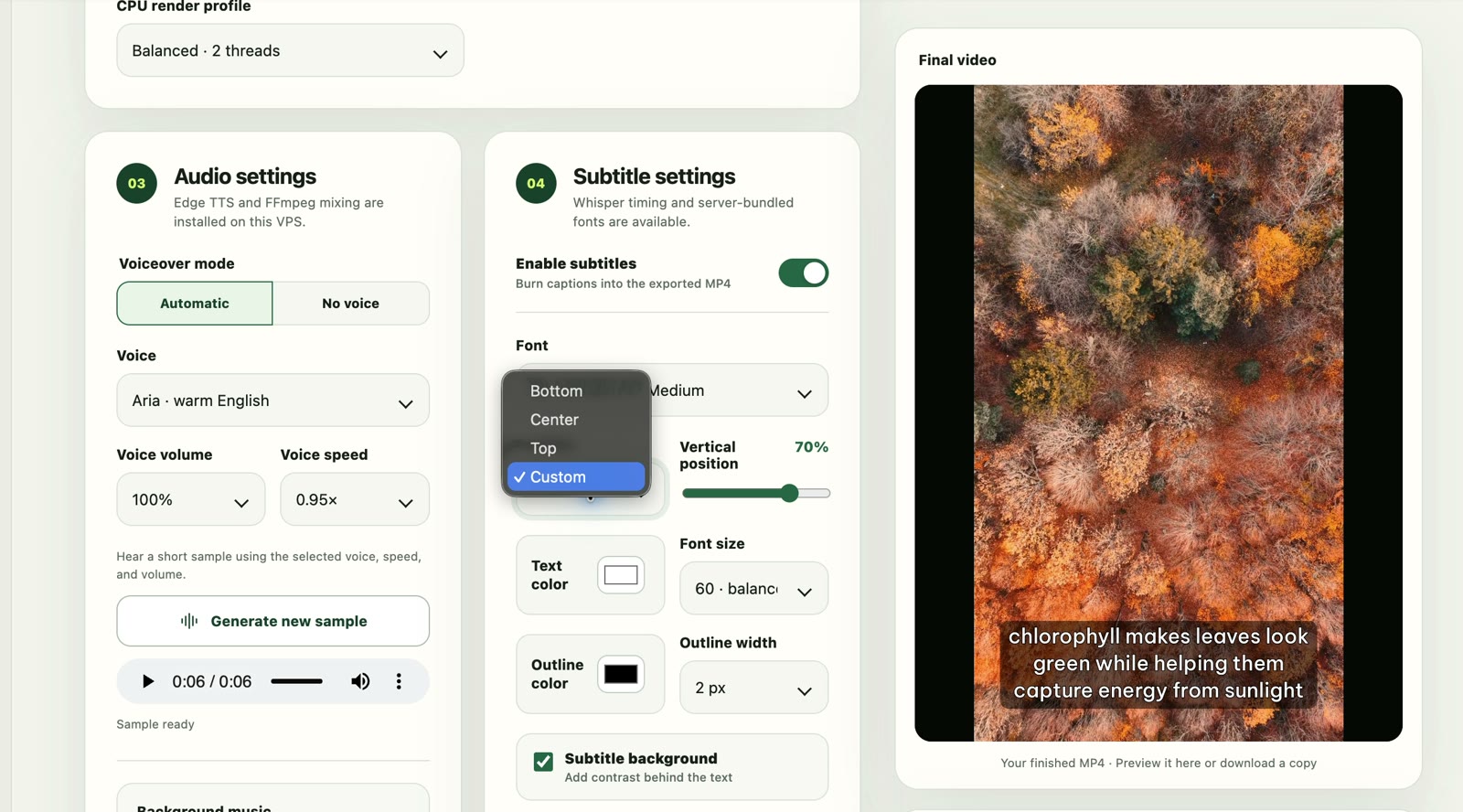
The complete case includes both recorded stages and the downloadable corrected MP4.
Inspect the caption evidence →Legal
Effective August 23, 2026 · Updated October 1, 2026
This Policy explains how StorySplice collects, uses, shares, and retains information when you visit storysplice.cloud, create an account, generate media, or contact support. StorySplice is currently a beta AI-assisted video creation service. Questions or privacy requests may be sent to support@storysplice.cloud.
When you register with email, we process your display name, email address, password hash, verification status, session information, and password-reset records. We do not store your plaintext password. If you use Google sign-in, we receive the basic account information Google makes available for authentication, such as your name, email address, profile image, and a provider-specific account identifier. StorySplice does not request access to Google Drive, Gmail, YouTube, or your Google password.
We process the topics, scripts, prompts, keywords, voice and subtitle settings, uploaded local videos, uploaded background music, job status, generated audio, stock-footage selections, captions, and finished videos needed to provide the Service. Support messages and any files or information you choose to send us are also processed.
Our servers may record IP address, request time, browser or device information, requested URLs, error details, and security events. We use essential cookies or similar session storage to keep you signed in and protect your account. StorySplice does not currently use advertising cookies or third-party behavioral analytics.
The homepage demo and its thumbnail are hosted by StorySplice. Playing the demo does not load a YouTube player or third-party tracking. The alternative “Watch on YouTube” link opens YouTube, where Google’s own privacy policy applies. See our cookie notice for details.
Where applicable, we rely on performance of our contract with you, legitimate interests in operating and securing the Service, consent where requested, and compliance with legal obligations.
StorySplice is an independent application built on third-party AI models and services, not the developer of those models. Inputs needed for writing, media search, narration or scene generation are sent to the relevant provider. Avoid submitting confidential or sensitive personal information in your topics, scripts and prompts.
We share information only as needed to provide or protect the Service. Current service providers and integrations may include:
We may also disclose information when required by law, to investigate fraud or security incidents, to protect legal rights, or as part of a business reorganization subject to appropriate safeguards. We do not sell personal information or Google user data.
Google account information is used only to create and secure your StorySplice account, display your account identity, and maintain your authenticated session. We do not use Google user data for advertising, sell it, or permit humans to read it except when necessary for security, support requested by you, legal compliance, or operation of the authentication service. You can revoke StorySplice access through your Google Account settings, though revocation does not automatically delete the StorySplice account record already created.
Generated task media—including intermediate files, narration, uploaded local videos, uploaded background music, voice samples, captions, and completed video files—is scheduled for automatic deletion from active task storage after seven days. You can permanently delete a completed or failed video earlier from Your recent videos. Voice-preview access tokens normally expire within thirty minutes, although the underlying generated sample remains subject to the seven-day task cleanup.
Account information, authentication records, support correspondence, security logs, and project metadata may be retained while your account is active and afterwards when reasonably necessary for security, legal compliance, dispute resolution, or service administration. Backup copies may remain until the relevant backup cycle expires. Download any video you wish to keep before its deletion date.
You may request account or personal-data deletion by emailing support@storysplice.cloud. We may need to verify your identity and may retain limited records where legally required or necessary to prevent abuse.
We use HTTPS, restricted server credentials, access controls, private per-user media routes, password hashing, rate limits, and operational monitoring. No online service can guarantee absolute security. You are responsible for using a strong password and protecting access to your email and Google account.
StorySplice and its service providers may process information in countries other than your own. Where required, we use appropriate contractual or legal safeguards for cross-border processing.
Depending on your location, you may have rights to access, correct, delete, restrict, or object to processing, or obtain a portable copy of certain personal information. You may also withdraw consent where processing relies on consent and complain to an applicable data-protection authority. Contact us to exercise a request.
The Service is not directed to anyone under 18, and we do not knowingly collect personal information from children. Contact us if you believe a child has provided information to StorySplice.
We may update this Policy as the beta, its providers, or legal requirements change. We will post the revised effective date and provide additional notice when required by law.
Email privacy questions or requests to support@storysplice.cloud.
Legal
Effective August 23, 2026 · Updated October 1, 2026
StorySplice is an independent application that uses third-party AI models and services. Standard video creation assembles existing stock or uploaded footage; editable AI-assisted writing and synthetic narration are separate from the experimental generation of new visual scenes. Third-party providers do not endorse StorySplice.
These Terms govern access to storysplice.cloud and the StorySplice AI-assisted video creation service (the “Service”). By creating an account or using the Service, you agree to these Terms and the Privacy Policy. If you do not agree, do not use the Service.
You must be at least 18 and legally able to enter this agreement. If you use StorySplice for an organization, you confirm that you have authority to bind it. StorySplice is in beta: features may be incomplete, changed, rate-limited, interrupted, or removed as we test and improve the Service.
Provide accurate registration information, keep credentials confidential, and promptly notify us of suspected unauthorized access. You are responsible for activity conducted through your account. You may not sell, transfer, share, or use another person’s account without authorization.
You retain rights you already hold in topics, scripts, prompts, files, branding, and other material you submit (“Input”). You grant StorySplice a limited license to host, process, reproduce, and transmit Input only as needed to operate, secure, and improve the Service.
As between you and StorySplice, and to the extent permitted by law, you may use generated output for lawful personal or commercial purposes. AI output may not be unique, and similar material may be produced for other users. StorySplice does not guarantee that output is accurate, original, protectable, non-infringing, or suitable for a particular purpose.
You are responsible for reviewing every script, claim, caption, voiceover, visual, and finished video before publishing. You must obtain all rights, permissions, releases, and licenses required for your Input and intended use, including rights involving copyright, trademarks, music, privacy, publicity, faces, voices, and likenesses. Stock media and third-party platforms remain subject to their own licenses and rules.
You may not use StorySplice to:
We may remove content, restrict generation, suspend accounts, or preserve and report information where reasonably necessary to address abuse, security threats, legal process, or repeated infringement.
StorySplice is a creation tool, not an editor, publisher, fact checker, lawyer, financial adviser, medical professional, or platform-approval service. Generated scripts and media can contain errors, bias, outdated information, unexpected content, or third-party material. You—not StorySplice—decide whether, where, and how output is published and are responsible for required disclosures, substantiation, and compliance.
We do not guarantee acceptance, reach, advertising approval, monetization, revenue, engagement, or continued availability on YouTube, TikTok, Instagram, or any other platform. Third-party platforms may remove content or restrict accounts under policies StorySplice does not control.
The Service depends on providers such as Google, Hostinger, Resend, Kimi, Pexels, and Microsoft text-to-speech services. Their availability, pricing, output, and terms can change independently. StorySplice is not responsible for outages or decisions made by those providers, but we will use reasonable efforts to maintain the Service.
Generated task media is temporary and scheduled for deletion after seven days. You are responsible for previewing and downloading files you want to keep. Account records and limited project metadata may remain as described in the Privacy Policy. We may remove abandoned, unlawful, unsafe, or technically harmful content sooner.
See the Refund & Cancellation Policy for payment inquiries, planned cancellation terms and the distinction between restoring AI credits and refunding a payment. Paid checkout remains unavailable.
Free Trial provides 30 one-time AI credits. Standard video submissions reserve 10 credits for a maximum length up to 30 seconds or 15 credits for 31–60 seconds, including any end card. Confirmed failed renders have their credits restored automatically. Unconfirmed submissions stay reserved until resolved. Previewing or downloading an existing video does not use credits.
Both plans have separate beta capacity limits: one active render per account and two submissions per day, resetting at 00:00 UTC. Failed submissions count toward this daily limit. Attempts to circumvent limits are prohibited. Experimental AI scenes require a separate invitation and are excluded from Creator Beta credits.
Creator Beta is planned at $15/month with 300 AI credits per monthly billing period. Paid checkout is not enabled. Once launched, subscriptions will renew monthly until canceled; cancellation stops future renewals and access continues through the paid period. Unused monthly credits will not roll over. Existing paid periods keep their original allowance and expiration date. Applicable taxes, final charges and refund terms will be shown before purchase; statutory rights are unaffected. Registering does not authorize a charge. See Pricing or contact Support.
StorySplice’s software, interface, branding, documentation, and underlying systems are owned by or licensed to the StorySplice operator. These Terms provide a limited, revocable, non-exclusive, non-transferable right to use the Service; they do not transfer ownership of the platform or its technology.
You may stop using the Service at any time. We may limit, suspend, or terminate access when we reasonably believe you violated these Terms, created security or legal risk, failed to pay an applicable future charge, or materially harmed the Service or others. Where practical and lawful, we will provide notice and an opportunity to address the issue.
To the maximum extent permitted by law, the Service is provided “as available” without warranties of uninterrupted operation, merchantability, fitness for a particular purpose, non-infringement, or accuracy. Nothing in these Terms excludes warranties or consumer rights that cannot legally be excluded.
To the maximum extent permitted by law, StorySplice and its operator will not be liable for indirect, incidental, special, exemplary, punitive, or consequential loss, or for lost profit, revenue, data, goodwill, business opportunity, platform access, or expected savings arising from the Service. StorySplice’s aggregate liability for claims relating to the Service will not exceed the greater of the amount you paid StorySplice during the twelve months before the event giving rise to the claim or USD 100. These limits do not apply where liability cannot lawfully be limited.
To the extent permitted by law, you will defend and indemnify StorySplice and its operator against third-party claims, damages, and reasonable costs arising from your Input, output, publication, unlawful use, infringement, or material breach of these Terms. This obligation does not apply to the extent a claim was caused by StorySplice’s own unlawful conduct.
We may update the Service or these Terms. Material changes will receive notice when required, and the revised effective date will be posted. If a provision is unenforceable, the remainder stays effective. Failure to enforce a provision is not a waiver. Neither party is liable for delay caused by events beyond reasonable control.
Applicable law governs these Terms without removing mandatory protections available in your place of residence. Before filing a claim, contact us so the parties can attempt to resolve the issue in good faith.
Questions, notices, or infringement reports may be sent to support@storysplice.cloud. Include enough information for us to understand and investigate the request.
StorySplice support
Find quick answers for common beta issues or send one complete support request so we can understand the problem without unnecessary back-and-forth.
Never send your password, Google credentials, API keys, or other secrets.
Use the secure recovery flow for password problems. For account deletion, personal-data requests, or security concerns, email us from the address connected to your account.
Quick answers
Rendering combines stock footage, narration, captions, and FFmpeg encoding on the StorySplice server. A normal job may take several minutes. Refreshing the page will not cancel it. If the status does not change for an extended period, send the job ID to support.
Generated task media is kept temporarily and scheduled for deletion after seven days. Download every finished MP4 you want to keep.
Check spam, junk, promotions, and filtered folders, then confirm you entered the correct email address. Avoid requesting many links in quick succession because older links may expire or be replaced.
Confirm you are signed in with the same email or Google account used to create it. Videos older than seven days may already have been removed under the retention policy.
Paid checkout is not enabled. Our Refund & Cancellation Policy explains payment questions, planned subscription cancellation and why restored render credits are different from monetary refunds.
Creating an account starts a Free Trial with 30 one-time credits and no card requirement. Creator Beta subscriptions are coming soon at $15/month with 300 monthly credits. Paid checkout is not enabled and no subscription payment is collected. See Pricing for credit costs, restoration and beta limits. Registering does not start paid billing.
Send a single, detailed message to help us investigate efficiently. Beta support is handled by email and response times are not guaranteed.
From prompt to publish
One focused workspace for scripting, voice, footage, captions, preview, and download.
Shape the story, voice, visuals, and captions in one place.
Preview and download videos created during the last seven days.
Your completed and in-progress videos will appear here for seven days.
Try refreshing the page.